


This story was originally published by Reasons to be Cheerful
10 min read
As a taxi driver, Juan Barbosa should in theory be one of the strongest opponents of a crackdown on cars. But, puffing on a cigarette beside his vehicle on a sultry August afternoon, the inhabitant of Pontevedra, Spain, admits that he finds himself in something of an existential crisis.
“As a driver, I suffer,” says Barbosa, who has been ferrying passengers around the northwestern city for two decades. “We can’t enter certain areas unless we have a customer or a booking. We have to take longer routes. But as a pedestrian, life is better. I enjoy it when there are fewer vehicles around.”
Post-pandemic, pedestrian-first urban planning is now all the rage, from 15-minute cities to low-traffic zones and the rise of soft mobility (human-powered or low-emission electric transport). But Pontevedra, which is home to 85,000 people in the city and just under a million in the province, was way ahead of the curve. It technically began its war on cars last century. (In 1999, to be precise.)
Today Pontevedra, which fittingly is located on one of the world-famous Camino de Santiago pilgrimage routes, is considered perhaps the greatest example in the world when it comes to getting rid of cars. Every year, delegations of mayors, professors and city planners make their own pilgrimage to learn about this great vanishing act.
“Pontevedra is an influential example and something we speak of often,” says Mark Nieuwenhuijsen, director of the urban planning, environment and health initiative at ISGlobal, a public health research institute based in Barcelona. “Many cities are now following their direction: It reduces air pollution, noise, and livability improves.”
Over the course of the 20th century, the city came to be dominated by vehicles. By the late 1990s, an average of 80,000 cars drove through Pontevedra every day — astonishingly, according to the municipality, three times more than through Madrid and five times more than London. Many of these vehicles weren’t even heading for the city, but rather transiting to other destinations such as beach towns on the coast. Those that did stay would turn the city’s charming historic squares into parking lots.
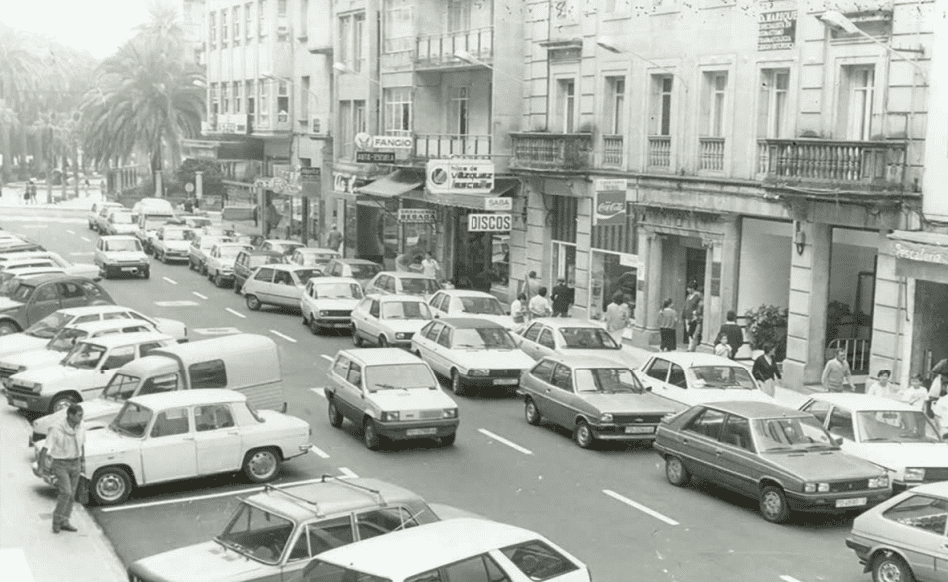
This came at a cost. Pontevedra’s epoch of cars dirtied the air, led to the deaths of pedestrians and seized centuries-old public spaces from residents.
“The city was loud, disagreeable, unlivable,” says Miguel Anxo Fernández Lores, the longstanding mayor of Pontevedra, from the desk of his city hall office. “All the roads were filled with cars. The city was like a huge, permanent traffic jam.”
Fernández Lores, a doctor by trade, decided enough was enough. In 1999, he campaigned to reclaim Pontevedra’s streets. The population agreed and elected him.
Yet the urban transformation was not overnight. It has been carried out gradually.
Fernández Lores began with a major effort to keep unnecessary cars out of the historic city center, removing significant amounts of on-street parking and only allowing essential vehicles to enter. Within one month in office, he had pedestrianized 300,000 square meters of the city center.
In other parts of the city, he narrowed roads and widened sidewalks, introduced 30 kilometer per hour speed limits citywide, down from 50 kilometers per hour, and began installing traffic-calming measures like raised pedestrian crosswalks as well as almost 300 speed bumps.
To take one example, the central Benito Corbel Street once had four lanes of traffic. In 2000, that was reduced to two lanes with widened sidewalks and trees. By 2014, it became a single-track road with only service vehicles able to enter, and even then for a limited time.
Weighed down by negative news?
Enter your email below to receive our smart, uplifting newsletters.
Or click here to choose exactly which ones you want
The mayor, who passed a Traffic and Mobility Plan for Pontevedra in 2011 formalizing and defining his pedestrian-first approach, also developed infrastructure to make it easier to ditch cars. The city now has roughly 4,500 private underground parking spaces and about 3,500 free “park and ride” spaces, all within a short walking distance from the center. Traffic lights were replaced by roundabouts to facilitate the flow of the remaining vehicles. In some central areas, the speed limit was lowered to just 10 kilometers per hour. Trees, green spaces and street lighting were also added to improve livability.
But despite its reputation, Pontevedra is not completely car-free — it allows certain vehicles on its streets within reason. “It’s not a city without cars,” says Fernández Lores. “But we only let the ones that really need to come here in.”

Residents can drive to garaged parking spots in the city. People with disabilities are free to drive in Pontevedra as long as they have a permit. And vehicles used for emergencies and public services such as garbage and water trucks and ambulances are permitted 24/7. Home deliveries, house moving and loading and unloading by businesses are allowed, but only during certain hours. And indeed, taxi drivers like Barbosa may enter certain zones if they have a client or booking. When necessary, police can issue fines of several hundred euros, ensuring these limits are respected.
“I think it was very smart, the decisions they made,” says Mirian Calvo, a researcher and expert in urban design from Pontevedra. “And this philosophy, of mixed-traffic, prioritizing soft mobility, has been applied over 30 years, more or less.”
The results of Pontevedra’s policy to prioritize pedestrians in public spaces, sustained over more than a quarter of a century, are nothing short of stunning.
Car trips in the city center have fallen by 97 percent, according to official municipal figures. The air is markedly cleaner, with CO2 emissions dropping by about 70 percent. And the streets are much safer: There have been no traffic deaths since 2011, whereas between 1996 and 2006, 30 people died in traffic accidents. (Pontevedra has won European road safety awards in the process.)

In fact, about 90 percent of all journeys in the city center are by foot, with road safety so high that 80 percent of kids aged 6 to 12 walk without their parents to school each morning. Many local business owners have signed up to be supervisors if the children need help for any reason.
For all the talk of the climate and safety benefits that come with limiting vehicle traffic and designing pedestrian-first urban spaces, however, there has been a surprising further advantage: Pontevedra is thriving economically.
While in the 1990s, retail activity was drifting towards the suburbs, the decision to prioritize a compact, walkable city with a high quality of life, has changed the picture drastically. The mayor, for his part, has rejected proposals to build malls on the urban periphery, protecting the pedestrian-oriented urban core. “We don’t want huge malls, we want small, independent businesses,” says Fernández Lores.
Pontevedra is now the fastest-growing city in the region of Galicia and in recent years has attracted 15,000 new inhabitants, mostly young families from elsewhere in northwest Spain. It also generates more jobs per capita than any other city in the region.

“It’s a very convenient city now,” says Calvo. “It’s a very nice city to live in and people can see that.”
Most locals are effusive in their praise. Esther Louzao, 68, says that her home near Plaza Pelegrina was once surrounded by cars, but not anymore. She has even stopped driving to work, instead opting to go by bus. But she keeps her car for beach days.
“I like it a lot, it’s easier to walk,” says Louzao, fittingly waiting at a bus stop.
Pacing down the street with a stroller, Anna, a 39-year-old with a toddler son who lives four kilometers out of town, agrees. “It’s better, much safer, it’s pleasant,” she explains. “Even if sometimes my journeys take a bit longer.”
Yet not all residents are entirely convinced by the policy. Manuel, who has been living in Pontevedra for 40 years, believes the transformation has been overstated. He owns three cars: one for the city, one for going to the beach and a third for sport driving. “Yes, the city is a lot different to how it was before,” says Manuel. “But it’s not as perfect as it seems. Some of us still need cars.”

Calvo agrees, noting that Pontevedra’s public transit network is lacking, which means that elderly people suffer and that cars must be taken to the coastal beaches. A system like Rome’s fleet of electric minibuses in the historic center could be implemented, she says.
And although the results of Pontevedra’s policy are hard to deny, Calvo, who is also a lecturer in participatory architecture, argues that the system could have been even more effective and popular if residents had been more involved in the process. In the 2000s, she says, there was significant opposition to the project, even if that has now disappeared due to the clearly positive impact.
“I don’t think there has been serious public engagement,” she says. “There are more things that could be done to make it more participatory.”
Nieuwenhuijsen, however, commends Pontevedra’s less confrontational approach, which presented the restriction of cars as about livability. “I think everyone would prefer places with less noise and less pollution,” he says. “It shouldn’t be about the war on cars, presented as punishing someone.”

In any case, cities across the world are following in Pontevedra’s pioneering footsteps. In 2019, Oslo became the first European capital to effectively make its city center car-free by removing on-street parking spaces and restricting access. Freiburg, Germany, has similarly transformed the district of Vauban into a car-free zone, banning on-street parking and introducing vehicle speed limits at walking pace on residential streets. And in 2022, the Spanish government approved a royal decree requiring all municipalities with over 50,000 inhabitants to have a low emission zone, and recommending the use of traffic-restricted areas like that of Pontevedra.
Yet not every place can easily replicate Pontevedra’s success. Professor Nieuwenhuijsen admits the transformation of North American cities could be more challenging given their size and lack of density. “U.S. cities were built around the car,” he says. “You get a lot of sprawl. European cities are different, many were designed for walking and horse carriages.”


Likewise, transforming larger cities will not be as easy. Redesigning urban areas could be slowed or halted by infrastructure such as underground piping, adds Nieuwenhuijsen, and the investment required could prove prohibitive. Barcelona’s Superblocks cost as little as €500,000 but as much as €10 million per unit in some cases.
But Fernández Lores, who is planning to run for an eighth term in 2027, believes that bigger cities could begin shifting away from cars and towards pedestrians by focusing on districts rather than entire cities. A case in point: In 2023, Culdesac Tempe, Arizona, became the first purpose-built, entirely car-free residential neighborhood in the U.S.
“Cities work without cars,” he says. “But each city must find its own way.”
The post The City That Kicked Out Cars Before It Was Cool appeared first on Reasons to be Cheerful.